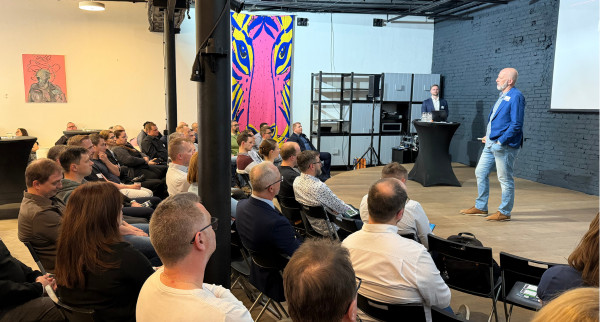
For two hundred years, humanity has made its living with its mind. The Industrial Revolution took our muscles, computing automated our calculations, and now AI is reaching for thinking itself. As Petr Beneš puts it: “Maybe the entire cognitive age was just a two-hundred-year anomaly.”
In this article, you'll learn:
- Why the jobs we considered protected are the first to disappear
- How companies are managing agents instead of people — and where human responsibility remains
- What is becoming more valuable in an agent-driven world, and why it’s worth betting on
- Which skills still matter once machines take over the routine
Cognitive Work Is Becoming a Commodity
Before 2022, everyone predicted that the least-skilled jobs would go first routine tasks, physical operations, repetitive processes. That’s not what happened.
The first to go are precisely the roles we considered protected. Junior IT positions in the US have dropped significantly over the past two years. The number of junior lawyers and financial analysts in the European Union has fallen by 35 to 40 percent. A partner at a major law firm described it plainly: “I have 40 associates and I don’t know what to do with them. The work I hired them for AI handles it now.”
J.P. Morgan analysed 200,000 contracts. Work that previously employed 350 lawyers.
Knowledge has stopped being scarce. AI delivers it instantly and at a fraction of the cost. An RFP document that used to take a team two months now gets done in three days and to a higher standard.
Without clean and accessible data, AI is nothing but an expensive generator of nonsense. You need to be clear about where your "source of truth" sits and what sources the agent draws its information from.

AI Competence Lead
The Career Ladder Is Broken
A senior consultant used to take six or seven years to build. Junior work was school through practice: reviewing legislation, correcting documents, preparing materials. That’s exactly what AI now does on its own.
The question that follows is: how do we develop the next generation of seniors? What do we give graduates to do when the work they used to learn on is simply no longer needed from them?
Leaders will have to think differently. Junior employees need to start learning to orchestrate agents rather than execute routine tasks. That demands entirely new models for onboarding, mentoring, and performance evaluation.
Agents Are the New Colleagues
Let’s stop saying “we use AI.” Instead, let’s say: “we work with agents.”
Companies with fifteen people and thirty-five agents already exist. Agents never sleep, never take holidays, never ask for a bigger bonus. But they have weaknesses too: they make mistakes, they have no emotions, and they bear no responsibility.
The human value-add shifts elsewhere to orchestration: deciding what agents should do and why. And to things that can’t be scaled to the cloud, human contact, trust, judgment in the face of uncertainty.
We Are Outsourcing Responsibility. Be Careful.
The MAVEN system in the Pentagon collects drone footage and analyses it. Palantir’s TITAN system proposes targets, prioritises strikes, recommends munitions. A human at the end responds to an algorithm.
Who is actually holding the trigger?
This is an extreme example. But the same dynamic plays out anywhere fatigue, time pressure, and trust in a system lead us to stop critically verifying outputs. Cognitive tools make us lazier. Knowledge is available instantly. But the responsibility for decisions cannot be transferred to an algorithm it stays with the human.
Working Class 2.0 Is Coming. What Won't AI Replace?
A different kind of manual work than we’ve known before.
While junior IT positions are falling, roles in healthcare, caregiving, and hospitality are growing. A skilled plumber now commands a higher hourly rate than the average lawyer. And in a few years, finding one will be even harder.
Things that cannot be replicated are becoming more expensive. Human touch, long-built trust, physical presence — AI won’t replace these. A song generated by an algorithm sounds nice the first time. By the twentieth listen, it’s still the same.
What to Do Right Now
Petr Beneš speaks from personal experience. A two-person company, eight to ten active agents. Instead of a PowerPoint business model proposal, he shows the client a working app prototype in two hours. Clients understand what’s being discussed much faster.
Three things worth starting immediately:
- Deploy at least one agent on a real business process. Not as a sandbox experiment. On actual work, where you’ll see what it can handle and where it fails.
- Stop hiring juniors for routine tasks. Start training them as orchestrators, people who manage agents, verify outputs, and take responsibility for decisions.
- Invest time in what AI won’t replace. Communication, empathy, judgment, leadership. Don’t ask “how can I use AI?” Ask “what do I want to say and achieve with AI’s help.”
The most valuable people in the years ahead won’t be those who can code. There’ll be those who know why.